A capacity-aware planning tool that turns a messy backlog into an explainable roadmap, then helps product teams explore risks, dependencies, delivery scenarios, and follow-up questions with AI.
NORTH-STAR METRIC
Activation: generate a roadmap, then ask AI or export itInstrumented at launch; the observed rate will be reported after sufficient usage.
PRODUCT AREARoadmap planning
FOCUSOutcome strategy and AI insights
TECHNOLOGYNext.js · TypeScript · Gemini · PostHog
See the AI Roadmap Assistant turn backlog inputs into a capacity-aware plan.
THE PROBLEM
A prioritized list was not yet a credible plan.
Product teams often maintain backlogs with inconsistent scoring, hidden dependencies, and little connection to delivery capacity. The result can look ordered while still leaving basic questions unanswered: what fits, what slips, and why?
HOW THE MVP WORKS
From backlog data to a roadmap teams can interrogate.
The MVP connects prioritization, capacity planning, dependency logic, visualization, and AI assistance in one flow. Users can start manually, import a CSV, explore editable sample data, and export the completed plan.
01
Set the planning assumptions
Choose a prioritization method, team size, delivery velocity, and planning window to define the constraints behind the roadmap.
02
Build the backlog
Capture initiatives, outcomes, effort, confidence, dependencies, and framework-specific inputs manually, through CSV import, or with editable sample data.
03
Plan, visualize, and export
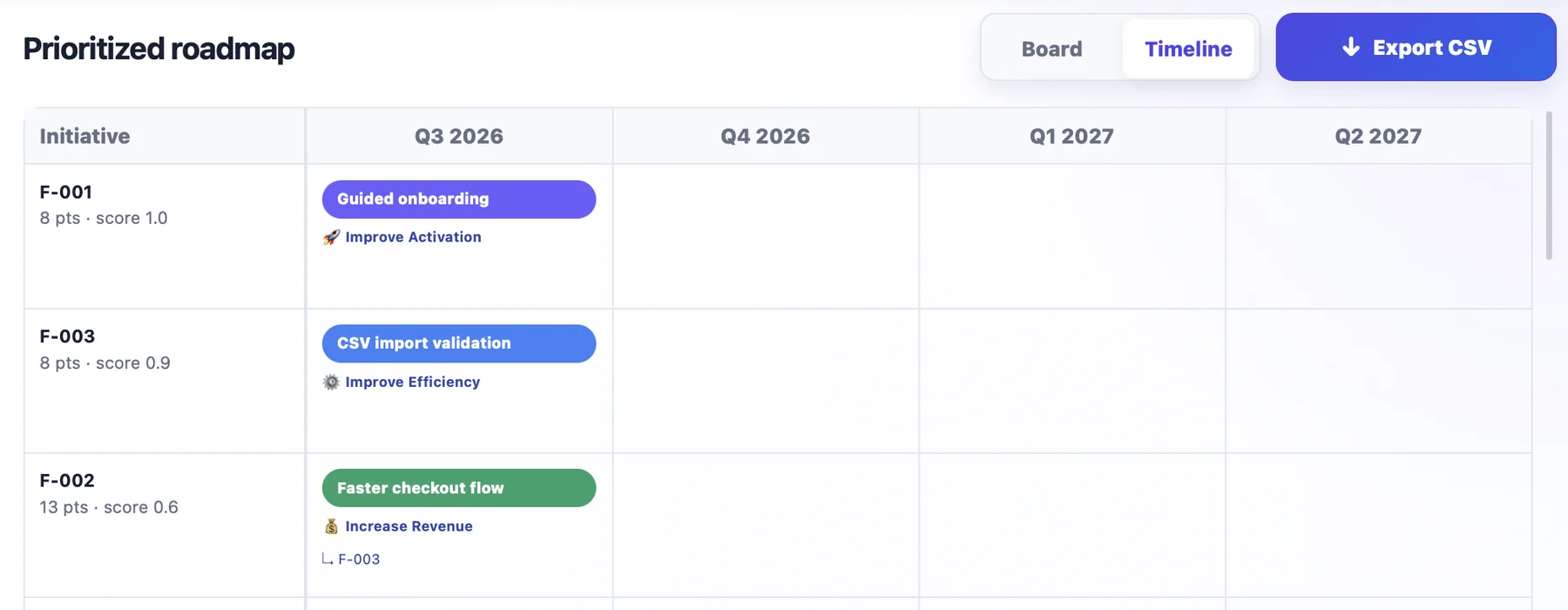
Scores initiatives with Simple, RICE, or WSJF, then builds a roadmap around available capacity and dependencies. Users can view it as a board or timeline and export it as CSV.
04
Explore with AI
Answers questions about timing, risk, capacity changes, dependencies, and outcomes using the generated roadmap as its bounded source of truth.
The timeline view makes initiative sequencing, quarterly capacity, dependencies, and delivery timing easier to scan.
ROADMAP INSIGHTS
Make strategic signals visible before asking AI.
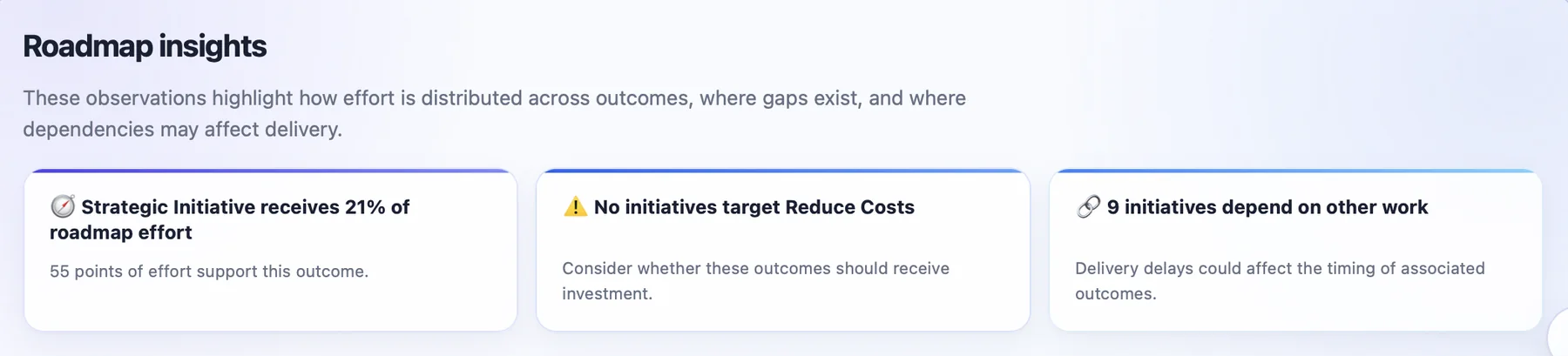
Once a roadmap is generated, deterministic insight cards highlight how effort is distributed across outcomes, where outcome gaps exist, and how dependencies may affect delivery. This gives product teams an immediate decision layer while providing grounded context for deeper AI follow-up questions.
Outcome allocation, strategic gaps, and dependencies at a glance.
PRODUCT DECISIONS
Deterministic planning first, AI explanation second.
01
Keep scoring transparent
Each framework exposes its inputs and formula. Product judgment remains visible, and users can edit assumptions before regenerating the roadmap.
02
Treat capacity as a planning constraint
The roadmap is built from team size, velocity, effort, and dependencies — not only from priority order.
03
Ground every AI answer
Deterministic calculations are reused when available. The assistant receives structured roadmap context, distinguishes facts from interpretation, and says when the available data is insufficient.
GROUNDED AI IN PRACTICE
From guided prompts to grounded roadmap answers.
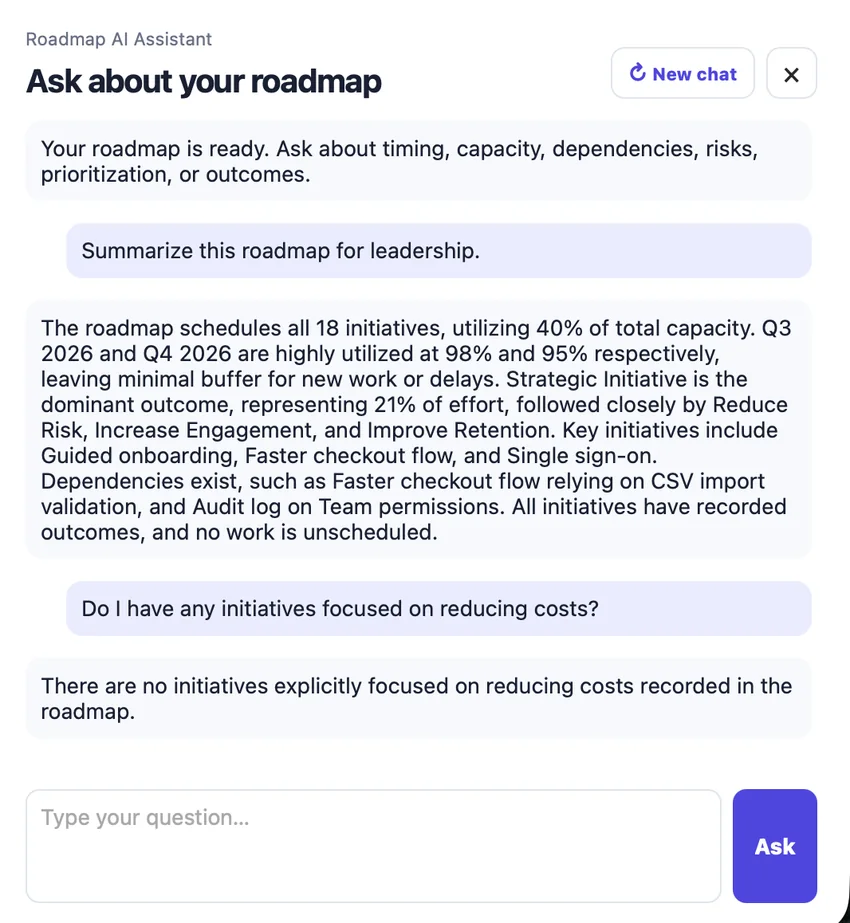
The assistant receives the generated roadmap and recent conversation as structured context. Scores, capacity, timing, and dependencies are calculated deterministically in the application, while a cost-efficient Gemini model explains those facts and connects relevant signals. It is instructed to distinguish facts from interpretation and acknowledge when the roadmap lacks sufficient information, reducing the risk of hallucinated answers. A per-user daily question limit also keeps operating costs predictable and discourages abuse.
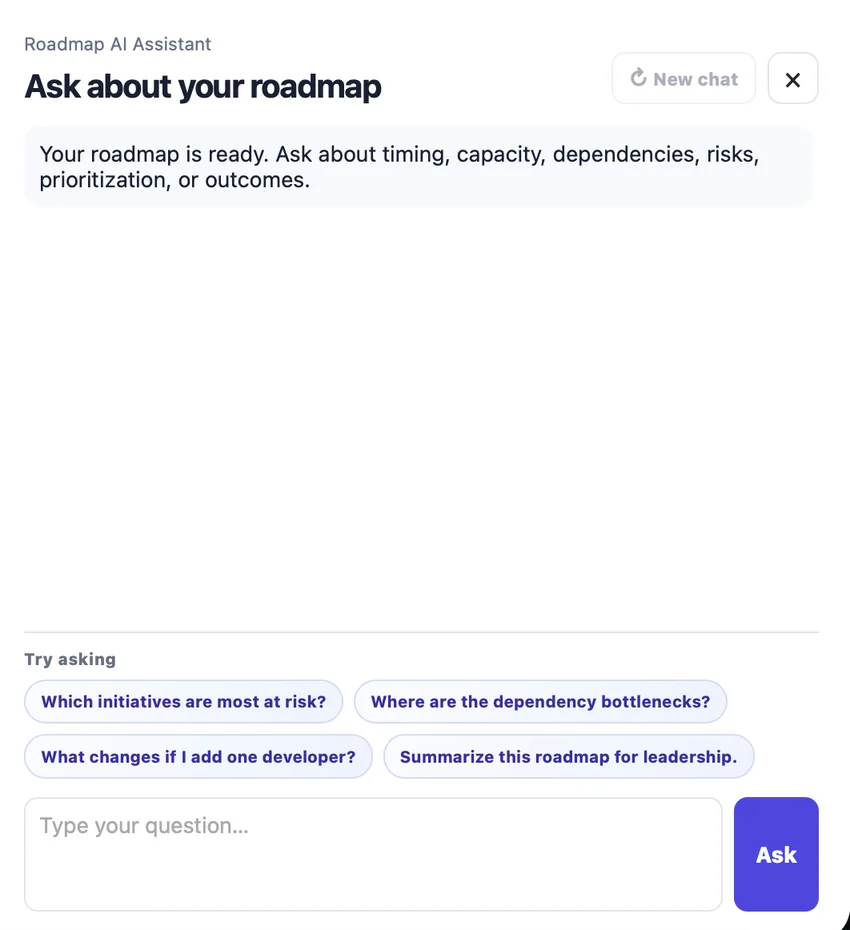
A focused starting point guides users toward useful questions about their roadmap.A grounded conversation summarizes the plan and confirms that no initiatives explicitly target cost reduction.
OUTCOME & LEARNING
A working planning loop, not just a generated roadmap.
The MVP supports the complete journey from backlog entry to prioritized plan, delivery-confidence signals, export, and follow-up analysis. Responsive board and timeline views make the same planning model usable across desktop and mobile.
KEY LEARNING
The strongest roadmaps begin with explicit priorities and intended outcomes. AI adds value when guardrails keep it grounded in that plan — helping teams explore trade-offs without hallucinating roadmap facts.
Current boundaries
The roadmap is a decision-support model, not a commitment or delivery forecast.
Results depend on the quality of effort, confidence, velocity, and dependency inputs.
Users cannot yet reshape the generated plan through drag-and-drop, manual priority overrides, or direct quarter-by-quarter adjustments.